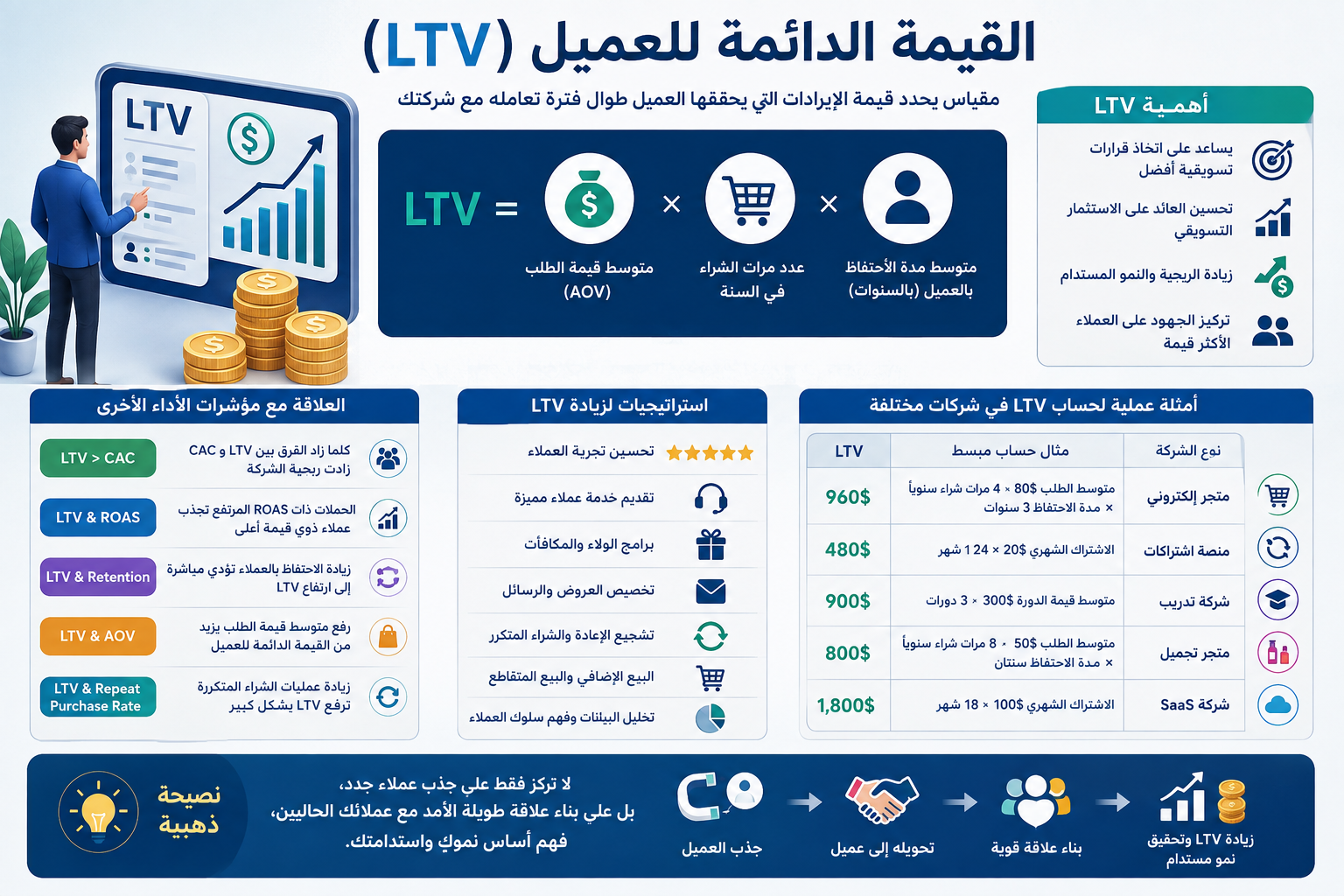
Customer Lifetime Value (LTV): The Comprehensive Guide to Understanding Your Customers' Value and Achieving Sustainable Growth
Introduction
In today’s competitive business environment, success is no longer based only on attracting new customers. Companies need to understand customer value and its impact on long-term growth. That is why businesses rely on different marketing metrics that help them make more accurate decisions and improve their strategies to achieve better results.
Analyzing customer behavior and measuring marketing performance allow companies to optimize their budgets, increase marketing efficiency, and build stronger relationships with customers. Understanding the connection between customer acquisition costs and the value generated by customers also helps businesses evaluate the profitability of their marketing strategies.
Many key performance indicators are connected to each other. Improving Conversion Rate helps increase the number of customers, while analyzing Customer Acquisition Cost (CAC) and Cost Per Acquisition (CPA) helps measure the effectiveness of marketing campaigns. By combining these metrics, businesses can create more effective marketing plans and achieve sustainable growth.
In this article, we will explore one of the most important metrics that helps businesses understand customer value, and how it can be used to improve marketing performance and increase long-term profitability.
What Is Customer Lifetime Value (LTV)?
Customer Lifetime Value (LTV) is a metric that shows the total expected revenue or profit that a company can generate from one customer throughout the entire period of their relationship with the brand. This value helps companies understand the importance of customers in the long term, not only the value of the first purchase.
LTV is used to determine customer profitability and helps companies make better decisions regarding marketing budgets, customer retention strategies, and product and service development. When a company knows the value generated by a customer throughout their relationship with it, it can determine the appropriate amount to invest in acquiring new customers.
The Customer Lifetime Value (LTV) is calculated using the following formula:
LTV = Average Purchase Value × Purchase Frequency × Average Customer Retention Duration
Example:
If the average customer purchase value is $100, the customer makes purchases 3 times per year, and stays with the company for 4 years:
LTV = 100 × 3 × 4 = $1,200
This means that the expected value of this customer throughout their relationship with the company is $1,200.
LTV is one of the most important metrics that helps companies achieve sustainable growth, especially when compared with Customer Acquisition Cost (CAC), as the customer value should be higher than the acquisition cost to ensure long-term profitability.
Why Is Customer Lifetime Value (LTV) Important for Businesses?
Customer Lifetime Value (LTV) is one of the most important metrics that helps businesses understand the long-term value of customers. It does not only focus on the current purchase but also helps determine the expected return from a customer throughout their entire relationship with the company.
LTV helps businesses make more accurate marketing decisions, such as determining the right budget for customer acquisition, developing customer retention strategies, and improving customer experience to increase loyalty and repeat purchases.
Understanding Customer Lifetime Value also helps businesses compare customer value with Customer Acquisition Cost (CAC), which shows the profitability of marketing campaigns and the efficiency of investing in acquiring new customers.
In addition, LTV helps businesses focus on their most valuable customers, improve products and services based on their needs, and achieve sustainable growth and increase profits in the long term.
How to Calculate Customer Lifetime Value (LTV)
Customer Lifetime Value (LTV) is calculated by determining the amount of revenue a customer generates throughout their relationship with the company. This calculation helps businesses estimate customer value and make better decisions regarding marketing and customer retention.
LTV is calculated using the following formula:
LTV = Average Purchase Value × Purchase Frequency × Average Customer Lifetime
Where:
- Average Purchase Value: The average amount a customer spends on each purchase.
- Purchase Frequency: The number of times a customer makes a purchase during a specific period.
- Average Customer Lifetime: The period of time a customer continues to do business with the company.
Practical Example:
If the average customer purchase value is $100, the customer makes purchases 4 times per year, and remains with the company for 3 years:
LTV = 100 × 4 × 3 = $1,200
This means that the expected lifetime value of this customer throughout their relationship with the company is $1,200.
Calculating LTV helps businesses determine the right investment in customer acquisition, especially when compared with Customer Acquisition Cost (CAC). This comparison helps companies understand whether marketing campaigns are generating long-term returns and profitability.
LTV Calculation Formula with a Practical Example

Customer Lifetime Value (LTV) is calculated using a simple formula that helps businesses understand the expected value generated by a customer throughout their relationship with the brand.
LTV Calculation Formula:
LTV = Average Purchase Value × Purchase Frequency × Average Customer Lifetime
Explanation of the formula elements:
- Average Purchase Value: The average amount a customer spends on each purchase.
- Purchase Frequency: The number of times a customer purchases from the company during a specific period.
- Average Customer Lifetime: The period during which a customer continues to do business with the company.
Practical Example:
If the average customer purchase value is $50, the customer makes purchases 5 times per year, and continues to do business with the company for 4 years:
LTV = 50 × 5 × 4
LTV = $1,000
This means that the expected value of this customer throughout their relationship with the company is $1,000.
This calculation helps businesses determine customer value, improve marketing strategies, and make better decisions about customer acquisition budgets, especially when comparing LTV with Customer Acquisition Cost (CAC).
Factors Affecting Customer Lifetime Value (LTV)
Customer Lifetime Value (LTV) is affected by several factors that determine the value a customer generates for a business throughout their relationship with the company. Understanding these factors helps businesses improve marketing strategies and increase customer profitability in the long term.
1. Average Purchase Value
The higher the amount a customer spends on each purchase, the higher the Customer Lifetime Value. Businesses can increase this factor by offering additional products, bundled offers, and improving the purchasing experience.
2. Purchase Frequency
It refers to the number of times a customer makes a purchase during a specific period. Increasing purchase frequency leads to higher customer value and greater revenue for the business.
3. Customer Retention Duration
The longer a customer continues doing business with a company, the more value they generate. Therefore, customer retention strategies and customer service play an important role in improving LTV.
4. Customer Experience
Customer experience directly affects customer loyalty and their decision to continue with a brand. A better shopping and service experience increases the possibility of repeat purchases.
5. Product & Service Quality
High-quality products and services help build customer trust, increasing the chances of retaining customers and improving their lifetime value.
6. Customer Loyalty
Customers with strong brand loyalty are more likely to make repeat purchases and have greater engagement with the company.
7. Marketing & Retention Strategies
Targeted marketing campaigns, loyalty programs, and continuous communication with customers play an important role in increasing customer value and improving LTV.
These factors are also connected to other marketing metrics discussed previously, such as Customer Acquisition Cost (CAC), Cost Per Acquisition (CPA), and Conversion Rate, as improving these metrics together helps increase customer profitability and achieve sustainable growth.
What Is the Difference Between LTV and CAC?
Customer Lifetime Value (LTV) and Customer Acquisition Cost (CAC) are two of the most important metrics that help businesses understand customer profitability and marketing efficiency. Although they are closely related, each metric measures a different part of the customer journey.
1. Customer Lifetime Value (LTV)
It measures the total value or revenue generated by a customer throughout their entire relationship with the company. It helps businesses understand the long-term importance of customers and identify their most valuable customers.
2. Customer Acquisition Cost (CAC)
It measures the average amount a company spends to acquire a new customer, including marketing costs, advertising expenses, sales costs, and all expenses related to attracting customers.
The Main Difference Between LTV and CAC:
Comparison LTV CAC Meaning Customer value throughout the entire relationship with the company The cost of acquiring a new customer Goal Understanding customer value and profitability Understanding customer acquisition cost Focus Revenue generated by the customer Money spent by the company to attract the customer Better Direction Higher LTV is better Lower CAC is betterPractical Example:
If a company spends $100 to acquire a new customer (CAC) and this customer generates $500 in revenue during their relationship with the company (LTV):
This means the company generates more value than the cost of acquiring the customer, which indicates a profitable marketing strategy.
Comparing LTV and CAC helps businesses evaluate the success of their marketing campaigns, determine the right customer acquisition budget, and achieve sustainable growth. These metrics are also connected to other indicators such as Conversion Rate and CPA (Cost Per Acquisition), as improving these metrics together helps increase marketing efficiency and improve return on investment.
What Is Customer Lifetime Value and How Do You Evaluate It?
The concept of Customer Lifetime Value (LTV) is not limited to knowing only the total revenue generated by a customer. It also extends to evaluating the customer's contribution to business growth and the company's profitability over the long term. Therefore, companies rely on a range of metrics and data to accurately assess the value of their customers and make more effective marketing and investment decisions.
Evaluating LTV begins by analyzing the Average Order Value (AOV), Purchase Frequency, and Customer Lifespan, as these represent the fundamental elements that determine the expected value of each customer.
Companies also take into account other factors that influence Customer Lifetime Value, such as the Customer Retention Rate, purchase frequency, customer loyalty, the value of the products or services they purchase, as well as the cost of serving and supporting the customer throughout their relationship with the brand.
Evaluating LTV is not limited to revenue alone. It is also compared with other metrics such as Customer Acquisition Cost (CAC) to determine customer profitability. If the Customer Lifetime Value is significantly higher than the Customer Acquisition Cost, it indicates that the company is achieving a strong return on its marketing investments. On the other hand, a lower ratio may require reviewing marketing strategies, improving the customer experience, and increasing customer retention rates.
Continuous evaluation of Customer Lifetime Value helps companies optimize their marketing strategies, allocate budgets more efficiently, develop loyalty programs, and enhance the customer experience, all of which contribute to achieving sustainable growth and increasing long-term profitability.
The Difference Between a New Customer and a High-Value Customer
Not every new customer is necessarily a high-value customer for a brand. A customer may make a single purchase and never return to the company, while another customer continues to make repeat purchases for years, generating higher revenue and greater long-term value.
For this reason, modern businesses do not evaluate their success based solely on the number of new customers they acquire. Instead, they also focus on customers who generate the highest Customer Lifetime Value (LTV), as these customers represent the greatest source of revenue and sustainable profitability.
Comparison New Customer High-Value Customer Relationship with the Company Short-term or unknown Long-term and ongoing Purchase Frequency One purchase or a limited number of purchases Frequent repeat purchases Total Revenue Relatively low High over the long term Loyalty Level May be low High Cost of Retention May be high initially Lower relative to the value generated Impact on Business Growth Limited Significant and sustainableFor example, a company may acquire a new customer who purchases a product worth £50 and never returns. Another customer may purchase products worth £100 four times a year for three years, generating a total value of £1,200. Although both customers started as new customers, the second customer is considered a high-value customer because they generate greater revenue and maintain a longer relationship with the brand.
For this reason, companies strive to convert new customers into high-value customers by improving the customer experience, offering loyalty programs, running Retargeting campaigns, providing exceptional customer service, and delivering personalized offers that encourage repeat purchases and help build a long-term relationship with the brand.
How to Increase Customer Lifetime Value (LTV)
Increasing Lifetime Value (LTV) does not depend only on attracting more customers, but also on building long-term relationships with them and encouraging them to continue engaging with the brand. The more value a customer generates throughout their relationship with the company, the higher the business profitability becomes, and the more efficient marketing investments become.
There are many strategies that help companies increase LTV, including:
1. Improving Customer Experience
Customer experience is one of the most important factors that influence customer retention with a brand. The easier and more professional the purchasing process or service experience is, the more likely customers are to return and make new purchases.
2. Increasing Customer Retention Rate
Retaining existing customers is less expensive than acquiring new ones. Therefore, companies develop strategies to maintain current customers, such as providing excellent customer service, continuous follow-up, and quickly resolving customer issues.
3. Encouraging Repeat Purchases
Encouraging customers to make frequent purchases helps increase their Lifetime Value. This can be achieved by offering special deals, discounts for existing customers, or recommending products and services that match their needs.
4. Developing Loyalty Programs
Loyalty Programs are among the most effective methods for increasing LTV. They provide customers with benefits, points, or rewards in exchange for continued purchases, which strengthens their connection with the brand and increases customer retention rates.
5. Using Retargeting Campaigns
Retargeting campaigns help reconnect with customers who have previously visited the website or made purchases, increasing the chances of bringing them back and encouraging them to complete new purchases.
6. Improving Product and Service Quality
The higher the quality of a product or service, the more customers trust the brand. This makes them more willing to purchase again or recommend the brand to others, which directly contributes to increasing LTV.
7. Providing a Personalized Experience (Personalization)
Personalizing offers, marketing messages, and recommendations based on each customer's interests and behavior helps improve the user experience and increases the likelihood of repeat purchases, which raises Customer Lifetime Value.
8. Using Data and Analyzing Customer Behavior
Analyzing customer data helps companies understand customer needs, predict purchasing behavior, and identify the best opportunities to increase sales and improve retention. This contributes to enhancing Lifetime Value (LTV) in the long term.
By combining these strategies, companies can increase the value generated by each customer, strengthen customer relationships, and achieve sustainable growth based on profitability and customer retention, rather than relying only on increasing the number of new customers.
Strategies to Improve Customer Retention and Increase Loyalty
Customer Retention is one of the most important factors that help companies increase Customer Lifetime Value (LTV) and achieve sustainable growth. Retaining existing customers is often less expensive than acquiring new ones. Additionally, loyal customers tend to make purchases more frequently, spend more money, and recommend the brand to others.
Therefore, successful companies rely on a set of strategies that help strengthen customer loyalty and build long-term relationships with them, including:
1. Providing an Outstanding Customer Experience
Customer experience is one of the most influential factors in a customer's decision to continue with a brand. The easier, faster, and more convenient the purchasing process or service experience is, the more likely customers are to return and make new purchases.
2. Developing Loyalty Programs
Loyalty Programs encourage customers to continue engaging with the brand by offering rewards, points, discounts, or exclusive benefits in exchange for repeat purchases. This strengthens their connection with the company and increases customer retention rates.
3. Providing Professional Customer Service
Responding quickly to customer inquiries, resolving issues efficiently, and providing continuous support help build trust and improve customer satisfaction, increasing the likelihood of customers continuing their relationship with the brand.
4. Personalizing the Customer Experience (Personalization)
Modern marketing relies on providing a personalized experience for each customer by recommending suitable products, sending personalized offers, and using customer data to deliver content that matches their interests and needs.
5. Maintaining Continuous Communication with Customers
Maintaining regular communication with customers through email, text messages, or social media helps strengthen relationships, keep customers informed about new offers and products, and increase opportunities for repeat purchases.
6. Using Retargeting Campaigns
Retargeting campaigns are among the most effective tools for re-engaging customers who have previously visited the website or purchased products, encouraging them to return and complete new purchases.
7. Improving Product and Service Quality
The higher the quality of products or services, the more customers trust the brand. They become more willing to continue doing business with it and recommend it to others, which directly contributes to increasing customer loyalty.
8. Listening to Customer Feedback
Collecting and analyzing customer feedback helps identify strengths and improvement opportunities, enabling companies to develop their products and services according to customer needs and expectations.
9. Building Long-Term Customer Relationships
Loyalty is not limited to completing purchases only. It also depends on building a relationship based on trust, transparency, and continuously providing value to customers, making the brand their first choice when making purchasing decisions.
By implementing these strategies, companies can improve customer retention rates, increase loyalty, and enhance Customer Lifetime Value (LTV), contributing to sustainable growth and stronger long-term profitability.
The Role of Customer Experience in Improving Customer Lifetime Value (LTV)
Customer Experience (CX) is one of the most important factors that influence Customer Lifetime Value (LTV) because it plays a direct role in enhancing customer satisfaction, increasing loyalty, and encouraging customers to continue engaging with the brand for longer periods. The more positive the customer experience is, the more likely customers are to make repeat purchases and the greater the value they generate for the company in the long term.
Customer experience is not limited only to product or service quality. It includes all stages of the customer journey, starting from discovering the brand, moving through the purchasing process, and reaching after-sales services and technical support. Therefore, companies strive to provide a complete and seamless experience that strengthens customer trust and encourages them to build a long-term relationship with the brand.
How Does Customer Experience Increase LTV?
1. Increasing Customer Retention Rate
When customers receive a positive experience, they are more likely to continue doing business with the company, which increases their retention period and raises the Lifetime Value they generate.
2. Encouraging Repeat Purchases
Customer satisfaction with the purchasing experience increases their desire to return and purchase products or services again, leading to a higher purchase frequency and increased LTV.
3. Enhancing Customer Loyalty
A great customer experience helps build a relationship based on trust between the customer and the brand, making customers more loyal and less likely to switch to competitors.
4. Increasing Average Order Value
When customers trust a brand, they become more willing to purchase additional products or higher-value services, which increases the average order value and boosts the revenue they generate throughout their relationship with the company.
5. Strengthening Word-of-Mouth Marketing
Satisfied customers tend to share their positive experiences with others, either through personal recommendations or social media, helping companies attract new customers without incurring high marketing costs.
6. Reducing Customer Churn Rate
The better the customer experience becomes, the lower the rate of customers leaving the brand. This helps increase the length of the customer relationship and improves their Lifetime Value.
How Can Customer Experience Be Improved?
Companies can improve customer experience by providing professional customer service, simplifying the purchasing process, personalizing offers and marketing messages, responding quickly to customer inquiries, improving product and service quality, and using customer feedback to continuously enhance the user experience.
Customer experience is a fundamental element in building long-term customer relationships. It not only helps achieve customer satisfaction but also contributes to increasing loyalty, improving retention rates, and enhancing Customer Lifetime Value (LTV), which supports business growth and strengthens long-term profitability.
The Impact of Customer Service on Customer Lifetime Value (LTV)
Customer Service is one of the most important factors that directly influence Customer Lifetime Value (LTV) because it represents the continuous point of contact between the customer and the brand after completing the purchase process. The more professional, fast, and efficient the customer service is, the more customers trust the company, increasing the likelihood of them continuing to engage with it for longer periods.
The role of customer service is not limited to solving problems or answering inquiries. It also extends to building a positive experience that enhances customer satisfaction, encourages repeat purchases, and transforms customers into loyal customers who generate greater value for the brand in the long term.
How Does Customer Service Increase LTV?
1. Enhancing Customer Satisfaction
When customers receive fast and effective support, they feel that the company cares about their needs, which increases their satisfaction level and strengthens their trust in the brand.
2. Increasing Customer Retention Rate
Providing excellent customer service helps reduce the likelihood of customers switching to competitors, extending their relationship with the company and increasing the value they generate over time.
3. Encouraging Repeat Purchases
Customers who receive a positive support experience are more likely to return and make additional purchases because they feel confident that the company will provide assistance whenever needed.
4. Building Customer Loyalty
Excellent customer service is one of the most important factors in building a long-term relationship between customers and brands. It transforms existing customers into loyal customers who prefer to continue doing business with the company.
5. Reducing Customer Churn Rate
Quickly addressing complaints and issues helps reduce customer churn rates because many customers leave a brand due to poor service experiences rather than the quality of the product itself.
6. Improving Reputation and Increasing Recommendations
Customers who receive exceptional service are more likely to recommend the brand to their friends or share their positive experiences on social media, helping companies attract new customers without high marketing costs.
How Can Customer Service Be Improved?
Companies can improve customer service by training support teams on professional communication, responding quickly to inquiries, providing multiple communication channels, resolving issues efficiently, following up with customers after purchase, and using their opinions and feedback to continuously improve services.
Customer service is a long-term investment in business success because it not only contributes to increasing customer satisfaction but also helps improve retention rates, strengthen loyalty, and increase Customer Lifetime Value (LTV), leading to sustainable growth and higher brand profitability in the long term.
The Role of Content Marketing and Personalized Messaging in Increasing Customer Lifetime Value (LTV)Content Marketing and Personalized Messaging are among the most important strategies that help companies increase Customer Lifetime Value (LTV) because they contribute to building continuous relationships with customers, strengthening trust, and encouraging them to continue engaging with the brand for longer periods. Instead of focusing only on achieving a single sale, this approach aims to provide real value to customers at every stage of their journey, which increases customer retention rates and repeat purchases.
Content marketing relies on providing useful and relevant content that meets audience needs, while personalized messaging depends on using customer data and behavior to deliver offers and content that match each customer's interests. This makes the customer experience more connected to the brand and increases the likelihood of customers continuing their relationship with it.
How Does Content Marketing Contribute to Increasing LTV?
1. Building Trust with Customers
Educational, informative, and valuable content helps strengthen customer trust in the brand, making them more willing to purchase and continue engaging with it.
2. Enhancing Customer Loyalty
Providing continuous and valuable content helps maintain ongoing communication with customers, increasing their connection with the brand and encouraging them to return for future purchases.
3. Supporting Purchase Decisions
Content that explains product benefits, provides reviews, guides, and case studies helps customers make more confident purchasing decisions, increasing the chances of repeat purchases.
4. Increasing Brand Engagement
Engaging content contributes to increasing interaction through websites and social media platforms, strengthening the relationship between customers and the brand in the long term.
How Does Personalized Messaging Contribute to Increasing LTV?1. Providing a More Personalized Experience
Sending messages and offers that match customer interests and purchasing behavior helps customers feel valued, which enhances their satisfaction and loyalty.
2. Increasing Repeat Purchases
Personalized messages can be used to send product recommendations, special offers, or repurchase reminders, encouraging customers to make additional purchases.
3. Improving Customer Retention Rates
The Most Important Tools Used for LTV Analysis1. Google Analytics 4 (GA4)
Google Analytics 4 is one of the most important tools for analyzing websites and applications. It helps track user behavior, analyze their journey across the website, measure conversion rates, and monitor repeat visits and purchases, providing valuable data that helps estimate Customer Lifetime Value.
2. Customer Relationship Management (CRM) Systems
CRM systems such as Salesforce, HubSpot, and Zoho CRM help manage customer data, track purchase history, analyze customer behavior, and measure the length of the relationship with the brand, contributing to more accurate LTV calculations.
3. Shopify Analytics
The Shopify platform provides advanced reports and analytics that help e-commerce stores monitor customer performance, analyze average order value, purchase frequency, and customer retention rates. These are essential data points for calculating Customer Lifetime Value.
4. Data Analytics Tools and Business Intelligence Dashboards
Tools such as Looker Studio, Microsoft Power BI, and Tableau help integrate data from multiple sources and create interactive reports and dashboards that display various performance indicators, including LTV, CAC, Conversion Rate, and ROAS.
5. Email Marketing Tools
Platforms such as Mailchimp, Klaviyo, and Brevo provide important data about email open rates, clicks, purchase frequency, and customer responses to marketing campaigns, helping measure the impact of campaigns on increasing LTV.
6. User Behavior Analytics Tools
Tools such as Hotjar and Microsoft Clarity help understand how customers interact with websites through session recordings, Heatmaps, and user behavior analysis. This helps improve customer experience and increase retention rates.
7. Digital Advertising Management Tools
Platforms such as Google Ads, Meta Ads Manager, and TikTok Ads Manager provide detailed data about advertising campaign performance, customer acquisition costs, and conversion rates. This helps compare LTV with Customer Acquisition Cost (CAC) and evaluate campaign profitability.
Why Are These Tools Important?
Using these tools helps companies gain a deeper understanding of customer behavior, identify the most profitable customer segments, improve marketing and customer retention strategies, and make data-driven decisions instead of relying on assumptions.
They also contribute to improving Customer Lifetime Value (LTV) by continuously analyzing performance, identifying opportunities for improvement, strengthening customer loyalty, and achieving the best return on marketing investments.
Common Mistakes That Lead to a Decrease in Customer Lifetime Value (LTV)Customer Lifetime Value (LTV) does not depend only on completing the first purchase. Instead, it is linked to the company’s ability to retain customers, encourage repeat purchases, and build long-term relationships with them. However, many companies make mistakes that reduce customer value over time, leading to lower profits and higher costs of acquiring new customers.
Below are the most common mistakes that reduce LTV and how to avoid them.
1. Focusing on Customer Acquisition and Neglecting Retention
Some companies focus on attracting as many new customers as possible while neglecting existing customers after their first purchase. This leads to lower repeat purchase rates and increases dependence on advertising spending to continuously acquire new customers.
To achieve higher Lifetime Value, companies should invest in customer retention strategies such as loyalty programs, exclusive offers, and continuous post-purchase follow-up.
2. Poor Customer Experience
Customer experience directly affects the decision to continue engaging with a brand. If customers face difficulties during the purchasing process, delays in receiving support, or an unsatisfactory experience, they are less likely to return.
Therefore, companies should improve all customer touchpoints, from the website experience to after-sales service.
3. Neglecting After-Sales Service
Some business owners believe that the relationship with the customer ends once the purchase is completed. However, the stage after purchase is where customer loyalty is actually built.
Neglecting follow-ups, failing to request customer feedback, or ignoring customer issues reduces trust and, consequently, decreases Customer Lifetime Value.
4. Not Personalizing Offers and Content
Sending the same messages and offers to all customers reduces the effectiveness of marketing campaigns. Customers expect content that matches their interests and purchasing behavior.
Using customer data and segmenting customers into different groups helps provide personalized offers that increase the likelihood of repeat purchases and improve LTV.
5. Ignoring Existing Customers When Creating Marketing Campaigns
Some companies spend most of their budgets on attracting new customers while failing to create campaigns to re-engage existing customers.
Retargeting campaigns, email marketing, and special offers for existing customers are among the most effective methods for increasing Customer Lifetime Value.
6. Poor Product or Service Quality
Even the best marketing campaigns will not generate long-term value if the quality of the product or service does not meet customer expectations.
Satisfied customers return for future purchases and recommend the brand to others, while poor-quality products lead to customer loss and higher churn rates.
7. Ignoring Customer Feedback
Customer opinions provide a valuable opportunity to improve products and services, but some companies fail to benefit from them.
Listening to customer feedback and analyzing complaints helps improve the customer experience and reduce the reasons behind customer loss.
8. Lack of Loyalty Programs
Loyalty programs are among the most important methods for encouraging customers to continue engaging with a brand.
The absence of rewards, discounts, points, or exclusive benefits reduces customer retention opportunities compared to competitors.
9. Not Tracking Performance Metrics
Increasing LTV depends on continuously analyzing data. When companies do not monitor metrics such as:
- Customer Retention Rate
- Repeat Purchase Rate
- Average Order Value
- Customer Acquisition Cost (CAC)
they may fail to identify problems until profits begin to decline.
10. Focusing Only on Sales Without Building Customer Relationships
Successful brands do not focus only on selling. Instead, they build long-term relationships with customers by providing valuable content, continuous support, exceptional experiences, and effective communication.
The more customers feel genuinely valued and cared for, the more likely they are to continue engaging with the brand.
How to Avoid a Decrease in LTV?
Companies can maintain and increase customer value by:
- Improving customer experience across all stages of the purchasing journey.
- Providing fast and effective customer service.
- Creating loyalty programs and rewards for existing customers.
- Using content marketing and personalized messaging.
- Tracking performance indicators and analyzing data continuously.
- Focusing on product and service quality.
- Investing in customer retention as much as investing in customer acquisition.
Customer Lifetime Value (LTV) is one of the most important metrics that helps companies understand the true value generated by each customer throughout their relationship with the business. The calculation of LTV varies from one business to another depending on the nature of products or services, average purchase frequency, and customer retention period.
Below are several practical examples explaining how to calculate LTV across different industries.
Example 1: E-commerce Store
Assume an online clothing store has the following data:
- Average Order Value = £80
- Average Purchase Frequency per Year = 4 times
- Average Customer Retention Period = 3 years
The formula:
LTV = Average Order Value × Average Purchase Frequency × Customer Retention Period
LTV = £80 × 4 × 3 = £960
This means that each customer generates expected revenue of £960 for the store throughout their relationship with the brand.
Example 2: Digital Subscription Platform
If a digital streaming platform offers a monthly subscription of £20, and the customer remains subscribed for an average of 24 months, then:
LTV = £20 × 24 = £480
This means that the expected value of each subscriber is £480 throughout their subscription period.
Example 3: Training Services Company
If a training company sells educational courses, and the data is:
- Average Course Value = £300
- Average Number of Courses Purchased per Customer = 3 courses
Then:
LTV = £300 × 3 = £900
This means that each customer generates total revenue of £900 for the company.
Example 4: Cosmetics Store
If:
- Average Order Value = £50
- Average Purchases per Year = 8 times
- Average Customer Retention Period = 2 years
Then:
LTV = £50 × 8 × 2 = £800
This means that each customer generates an expected value of £800 throughout their relationship with the brand.
Example 5: SaaS Company
If a company provides a monthly subscription of £100, and the customer remains subscribed for 18 months, then:
LTV = £100 × 18 = £1,800
This means that each customer generates £1,800 for the company throughout their usage period.
Comparison Between Different Industries Industry Average Order / Subscription Value Purchase or Subscription Frequency Retention Period LTV E-commerce Store £80 4 times per year 3 years £960 Subscription Platform £20 monthly — 24 months £480 Training Company £300 3 courses — £900 Cosmetics Store £50 8 times annually 2 years £800 SaaS Company £100 monthly — 18 months £1,800 2. The Relationship Between LTV and Conversion RateConversion Rate reflects the ability of marketing campaigns to convert visitors into customers.
The higher the conversion rate, the more customers a company can acquire, retain, and transform into long-term customers, which contributes to increasing LTV over time.
Improving user experience, landing pages, and content quality also helps increase conversion rates, leading to higher Customer Lifetime Value.
3. The Relationship Between LTV and CPA (Cost Per Acquisition)
CPA measures the cost of obtaining a specific action, such as a purchase or account registration.
When acquisition costs decrease while maintaining customer quality, companies can invest their budgets more efficiently and acquire a larger number of high-value customers, which positively impacts LTV.
4. The Relationship Between LTV and ROAS (Return on Ad Spend)
ROAS measures the return generated from advertising spend.
A campaign may achieve a high ROAS in the short term, but if customers do not return for future purchases, the LTV may remain low.
However, when campaigns generate a good advertising return and attract customers who continue purchasing over long periods, both ROAS and LTV increase together.
5. The Relationship Between LTV and Retention Rate
Customer Retention Rate measures the percentage of customers who continue engaging with a company over a specific period.
The higher the customer retention rate, the longer the relationship with the brand becomes, which directly leads to higher LTV.
That is why companies invest in loyalty programs, customer service, and content marketing to retain their existing customers.
6. The Relationship Between LTV and Repeat Purchase Rate
Repeat Purchase Rate measures the number of customers who return to make additional purchases.
The more frequent the repeat purchases, the higher the revenue generated by each customer, resulting in an increase in Customer Lifetime Value (LTV).
7. The Relationship Between LTV and Average Order Value (AOV)
Average Order Value (AOV) measures the average value of a single order.
When the average order value increases through Upselling or Cross-selling, the revenue generated by each customer increases, leading to higher LTV.
8. The Relationship Between LTV and Customer Satisfaction
Customer satisfaction is not a direct financial metric, but it has a significant impact on Customer Lifetime Value.
Satisfied customers tend to:
- Make repeat purchases.
- Spend more money.
- Recommend the brand to others.
- Continue engaging with the company for longer periods.
All of these factors contribute to increasing LTV.
How Do These Metrics Work Together? Performance Indicator (KPI) Its Relationship with LTV CAC The lower the customer acquisition cost compared to LTV, the higher the company’s profitability. Conversion Rate Increasing the conversion rate means acquiring more customers who can be converted into long-term customers. CPA Lower acquisition costs help improve returns and increase customer value over the long term. ROAS Campaigns with high advertising returns help attract customers who generate greater value over time. Retention Rate A higher retention rate directly increases the length of the customer relationship and improves LTV. Repeat Purchase Rate Increasing repeat purchases raises Customer Lifetime Value. Average Order Value (AOV) Increasing the average order value leads to higher total revenue generated by each customer. Customer Satisfaction Customer satisfaction increases loyalty, encourages repeat purchases, and improves LTV. Expert Tips to Improve Customer Lifetime Value (LTV)Increasing Customer Lifetime Value (LTV) is one of the most important goals for companies because it helps achieve sustainable growth and increase profits without relying constantly on acquiring new customers. Marketing experts emphasize that improving LTV is not achieved through increasing sales only, but through building long-term relationships with customers and providing an exceptional experience that encourages them to continue engaging with the brand.
Below are some of the most important expert recommendations for increasing Customer Lifetime Value.
1. Focus on Customer Retention Before Customer Acquisition
Marketing experts emphasize that retaining existing customers is much less expensive than acquiring new ones. Therefore, companies should invest in improving customer experience, providing exceptional services, and building long-term relationships, which leads to higher repeat purchase rates and increased LTV.
2. Provide an Exceptional Customer Experience
Customer Lifetime Value begins with the experience customers have with the brand. The easier, faster, and smoother the purchasing experience is, the more likely customers are to return.
This includes:
- Easy browsing and purchasing.
- Fast order processing.
- Providing multiple payment options.
- Clear order tracking.
- Offering quick support when needed.
3. Use Data to Understand Your Customers
Successful companies rely on customer data analysis to understand:
- Most purchased products.
- Purchase times.
- Each customer’s interests.
- Customer behavior on websites or applications.
This helps provide more relevant offers and increases opportunities for repeat purchases.
4. Personalize Offers and Marketing Messages
Customers feel more valued when they receive offers that match their needs and interests.
Experts recommend using:
- Personalized emails.
- Smart product recommendations.
- Offers based on customer behavior.
- Personalized messages for different occasions.
5. Encourage Repeat Purchases
Repeat purchases are one of the fastest ways to increase LTV.
This can be achieved through:
- Special offers for existing customers.
- Discounts on second purchases.
- Gift vouchers.
- Reminders to repurchase frequently used products.
6. Provide Effective Loyalty Programs
Loyalty programs encourage customers to continue engaging with the brand.
Examples include:
- Collecting points.
- Rewards.
- Exclusive discounts.
- Gifts.
- Special member benefits.
All these methods increase customer connection with the brand and raise their Lifetime Value.
7. Invest in Customer Service
Customer service directly affects the customer’s decision to return and purchase again.
Experts recommend:
- Fast responses.
- Professional problem-solving.
- Post-purchase follow-up.
- Paying attention to customer complaints.
- Providing satisfactory solutions.
8. Use Upselling and Cross-selling
Upselling and Cross-selling help increase Average Order Value, which leads to higher LTV.
Examples:
- Suggesting a higher version of a product.
- Offering complementary products.
- Providing bundles and package deals.
9. Ask for Customer Feedback and Use It
Listening to customers helps continuously improve products and services.
Companies can use:
- Surveys.
- Customer ratings.
- Product reviews.
- Opinion polls.
to improve customer experience and increase retention rates.
10. Continuously Monitor Performance Metrics
LTV cannot be improved without tracking related performance indicators, such as:
- Customer Retention Rate
- Repeat Purchase Rate
- Average Order Value
- Customer Acquisition Cost (CAC)
- Conversion Rate
These metrics help identify improvement opportunities and support data-driven decision-making.
11. Maintain Continuous Communication with Customers
Communication with customers should not end after the first purchase.
Companies can maintain relationships through:
- Email newsletters.
- Educational content.
- New updates and offers.
- Occasion-based messages.
- Re-engagement campaigns.
The more valuable communication a brand provides, the higher the chances customers will continue engaging with it.
12. Make Building Trust a Priority
Trust is the foundation of long-term customer relationships. It can be strengthened through:
- Transparency in pricing.
- Commitment to delivery schedules.
- Providing high-quality products and services.
- Respecting customer privacy.
- Fulfilling marketing promises.
Customers who trust a brand are more likely to purchase repeatedly, which leads to higher Lifetime Value (LTV).
How Does LTV Help Companies Achieve Sustainable Growth and Profitability?Customer Lifetime Value (LTV) is one of the most important metrics that companies rely on when developing growth strategies. It does not focus only on revenue generated from a single purchase, but measures the total value a customer generates throughout their relationship with the brand. This metric helps companies make more accurate decisions and achieve a balance between acquiring customers and retaining them, supporting long-term growth and profitability.
1. Improving Marketing Return on Investment
LTV helps companies evaluate the effectiveness of their marketing spending and customer acquisition efforts. When Customer Lifetime Value is high, companies can invest confidently in marketing campaigns because they know that customers will generate revenue that exceeds the cost of acquiring them.
2. Supporting Data-Driven Decision Making
LTV provides clear insights into the most valuable customers, helping companies direct their investments toward segments that generate the highest returns. It also supports strategic decisions related to marketing, sales, customer service, and product development based on actual data rather than assumptions.
3. Increasing Company Profitability
Profitability does not depend only on increasing the number of customers, but also on increasing the value generated by each customer. LTV helps companies focus on retaining existing customers, encouraging repeat purchases, and increasing average order value, leading to higher profits without the need to significantly increase customer acquisition spending.
4. Improving Customer Retention Strategies
Analyzing LTV helps companies identify their most valuable customers and maintain them through improving customer experience, loyalty programs, personalized offers, and exceptional customer service. This increases the length of customer relationships and enhances their long-term value.
5. Improving Marketing Budget Allocation
By understanding the expected value of each customer, companies can allocate marketing budgets more efficiently and focus on channels and campaigns that attract high-value customers instead of relying only on sales volume or the number of customers.
6. Supporting Long-Term Financial Planning
LTV helps companies predict future revenue more accurately, contributing to more stable financial and investment plans and allowing growth goals to be set based on realistic data.
7. Strengthening the Relationship Between Marketing and Sales
LTV helps align the goals of marketing and sales teams. Success is not limited to attracting customers but extends to retaining them and increasing their value over time, which enhances collaboration between different departments to achieve company objectives.
8. Achieving a Sustainable Competitive Advantage
Companies that focus on increasing LTV do not only aim for quick sales but work on building long-term customer relationships. This leads to stronger loyalty, improved brand reputation, and sustainable growth that is difficult for competitors to replicate.
How Does LTV Contribute to Sustainable Growth? Role of LTV Impact on the Company Improving Return on Investment Increasing marketing spending efficiency Increasing Customer Profitability Generating higher long-term revenue Improving Customer Retention Reducing customer churn rate Supporting Decision Making Making data-driven decisions Improving Budget Allocation Investing resources in the most effective channels Revenue Forecasting More accurate financial planning Building Customer Loyalty Enhancing long-term growth and stability ConclusionCustomer Lifetime Value (LTV) is one of the most important performance indicators that helps companies build more efficient and sustainable marketing strategies. It does not focus only on revenue generated from a single purchase but measures the true value a customer creates throughout their relationship with the brand, giving companies deeper insights into customer profitability and the effectiveness of their marketing investments.
Throughout this guide, we explored the concept of LTV, its importance, how it is calculated, the factors that influence it, and its relationship with other performance metrics such as CAC, Conversion Rate, CPA, and ROAS. We also discussed the key strategies that help increase Customer Lifetime Value, starting with improving customer experience, strengthening loyalty programs, personalizing content and offers, enhancing customer service, and using data-driven decision-making.
LTV should not be viewed as just a formula or a number in marketing reports. Instead, it should be considered a strategic indicator that reflects a company’s ability to build long-term customer relationships and achieve sustainable growth based on trust, loyalty, and continuous value.
In today’s increasingly competitive digital markets, the most successful companies are those that do not only focus on attracting customers but also work on retaining them, increasing their value over time, and transforming them into loyal customers and brand advocates.
Ultimately, investing in increasing Lifetime Value (LTV) does not only mean increasing revenue. It means building more stable businesses, improving marketing efficiency, and strengthening long-term profitability, making LTV one of the most important metrics that should be at the core of any successful marketing strategy.