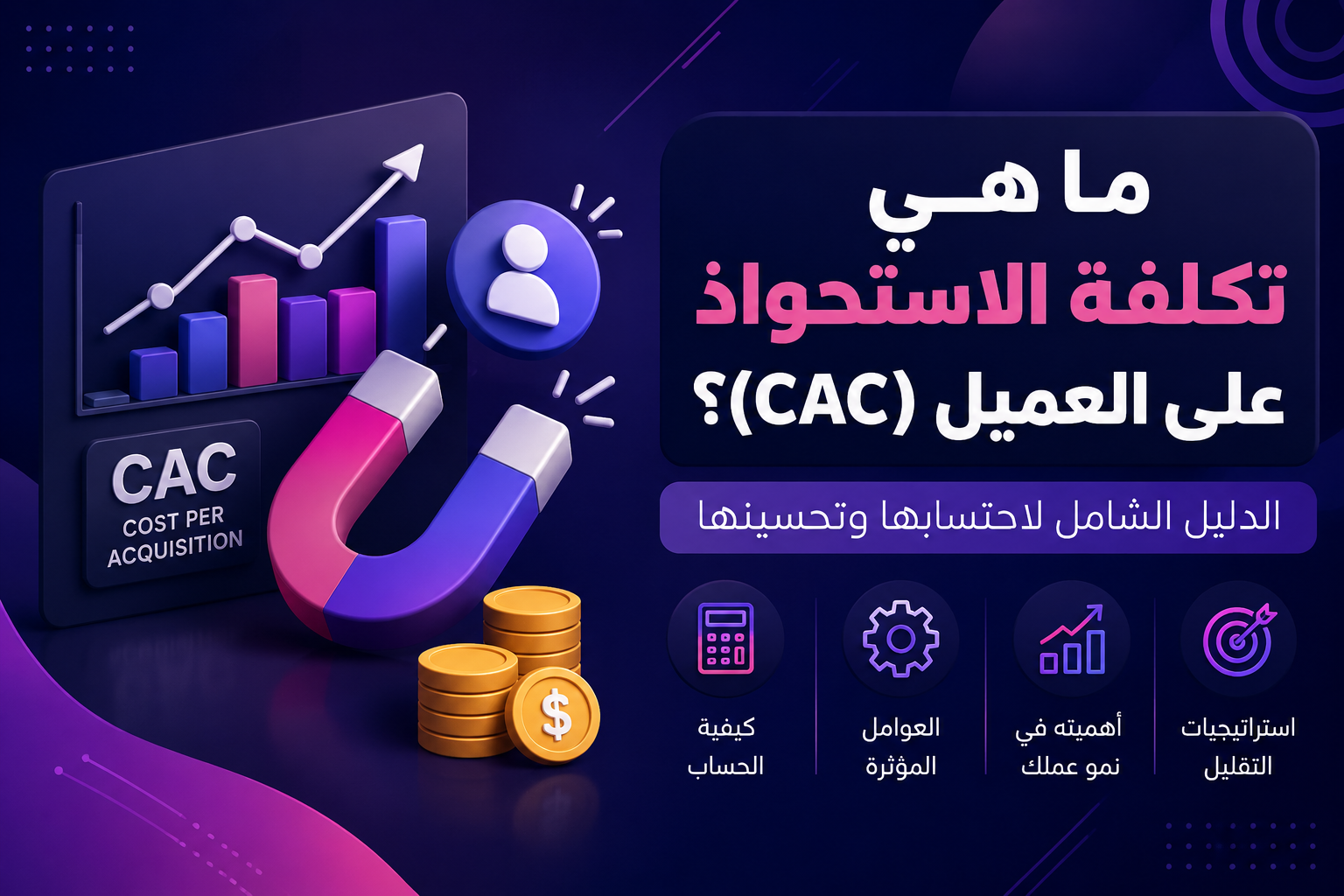
? What Is Customer Acquisition Cost (CAC) and How Does It Impact Your Business Growth and Profitabili
- Introduction
In the world of digital marketing, acquiring new customers has become one of the main goals for businesses. However, success does not depend only on the number of customers gained, but also on understanding the actual cost of acquiring each customer. This is where Customer Acquisition Cost (CAC) becomes important, as it is one of the key metrics that helps businesses evaluate the efficiency of their marketing and sales strategies.
Calculating CAC helps businesses measure the effectiveness of advertising campaigns, identify the best-performing channels, and optimize budget allocation for more sustainable growth. Understanding customer acquisition costs also allows companies to compare CAC with Customer Lifetime Value (LTV) to make more accurate marketing decisions.
Customer Acquisition Cost is directly connected to several important marketing metrics, such as Conversion Rate, which shows the percentage of visitors who become customers, Cost Per Acquisition (CPA), which helps measure the cost of achieving a specific action, and Return on Ad Spend (ROAS), which indicates how effectively advertising campaigns generate revenue.
In this article, we will explore what Customer Acquisition Cost (CAC) is, how to calculate it, its importance, the factors that affect it, and the best strategies businesses can use to reduce costs and improve marketing performance.
What Is Customer Acquisition Cost (CAC)?
Customer Acquisition Cost (CAC) is the total amount of money a business spends to acquire a new customer. It includes all costs related to marketing and sales efforts, such as paid advertising, marketing and sales team salaries, marketing tools, and content creation.
This metric is used to measure the efficiency of customer acquisition strategies and determine how much investment is required to gain each new customer. The lower the acquisition cost while maintaining customer quality, the better the company’s ability to achieve sustainable growth and profitability.
For example, if a company spends $10,000 on marketing and sales during a specific period and acquires 100 new cu

stomers, the Customer Acquisition Cost would be $100 per customer.
CAC is considered one of the most important marketing performance metrics because it helps businesses evaluate the suc
cess of advertising campaigns, especially when compared with other metrics such as Conversion Rate to understand how effectively campaigns and landing pages turn visitors into customers, Cost Per Acquisition (CPA) to measure the cost of achieving desired actions, and Return on Ad Spend (ROAS) to evaluate how effectively campaigns generate revenue.
Why Is CAC One of the Most Important Performance Metrics?
Customer Acquisition Cost (CAC) is one of the most important marketing performance metrics because it helps businesses understand the efficiency of their customer acquisition efforts compared to their marketing and sales spending. Without knowing the cost of acquiring each customer, companies may spend large budgets on campaigns without ensuring profitable returns.
Measuring CAC allows businesses to make more accurate decisions about budget allocation across different marketing channels and identify which campaigns deliver the best results at the lowest cost. It also helps determine whether the current growth strategy is sustainable or requires optimization.
CAC is directly connected to other important marketing metrics. Improving Conversion Rate helps businesses turn more visitors into customers, which can reduce customer acquisition costs. Additionally, comparing CAC with Customer Lifetime Value (LTV) helps companies understand the long-term profitability of acquired customers.
Analyzing CAC also helps optimize advertising performance across platforms such as Google Ads and Meta Ads, identify the most effective channels, reduce unnecessary spending, and achieve more efficient and sustainable business growth.
CAC vs CPA: What Is the Difference?
Although Customer Acquisition Cost (CAC) and Cost Per Acquisition/Action (CPA) may seem similar, they measure different aspects of marketing performance.
CAC measures the total cost a business spends to acquire an actual new customer. It includes all marketing and sales expenses, such as advertising costs, marketing and sales team salaries, marketing tools, and content creation expenses. Therefore, CAC is a broader metric used to understand the cost of growing a customer base.
On the other hand, CPA measures the cost of achieving a specific action from users. This action could be a purchase, sign-up, app download, or form submission. CPA is commonly used to analyze advertising campaign performance and measure the cost of each result generated.
Key Differences Between CAC and CPA:
Comparison CAC CPA Meaning Customer Acquisition Cost Cost Per Action/Acquisition Goal Measure the cost of gaining a new customer Measure the cost of achieving a specific action Includes Marketing + sales + customer acquisition costs Mainly campaign-related costs Usage Measure business growth and profitability Optimize advertising performance Scope Broader and more comprehensive More focused on campaignsFor example, if a company spends $20,000 on marketing and sales and gains 200 new customers:
CAC = $100 per customer

If an advertising campaign spends $5,000 and generates 500 sign-ups:
CPA = $10 per action
In conclusion, CPA helps improve advertising campaign performance, while CAC helps businesses understand the true cost of overall customer growth.
Both metrics are connected to other marketing indicators such as Conversion Rate, where improving conversion rates can reduce acquisition costs, and ROAS, which measures the return generated from advertising spend.
How to Calculate Customer Acquisition Cost (CAC)
Calculating Customer Acquisition Cost (CAC) is one of the most important steps in measuring the efficiency of a company's marketing and sales efforts. The calculation compares the total amount spent on marketing and sales with the number of new customers acquired during the same period.
CAC Formula:
Customer Acquisition Cost (CAC) = Total Marketing and Sales Costs ÷ Number of New Customers
To ensure accurate results, total costs should include all expenses related to acquiring customers, such as:
- Paid advertising costs.
- Marketing and sales team salaries.
- Marketing and analytics software subscriptions.
- Content creation and design costs.
- Sales commissions and performance incentives.
For example, if a company spends $15,000 on marketing and sales in one month and acquires 150 new customers, the calculation would be:
CAC = $15,000 ÷ 150 = $100 per customer
This metric helps businesses evaluate the efficiency of their marketing investments and compare the performance of different campaigns to identify the most cost-effective acquisition channels.
For a more complete performance analysis, CAC should be evaluated alongside other marketing metrics such as Conversion Rate, which measures how effectively visitors become customers, Cost Per Acquisition (CPA), which measures the cost of a specific action, and Return on Ad Spend (ROAS), which evaluates the revenue generated from advertising expenses.
Practical Example of Calculating Customer Acquisition Cost (CAC)
To better understand how Customer Acquisition Cost (CAC) is calculated, let's consider an example of an e-commerce company running a one-month marketing campaign to acquire new customers.
During the campaign, the company spent:
- $8,000 on paid advertising.
- $4,000 on marketing and sales team salaries.
- $2,000 on marketing and analytics tools.
- $1,000 on content creation and design.
Total Marketing and Sales Costs = $15,000
During the same period, the company acquired 150 new customers.
The CAC formula is:
CAC = Total Marketing and Sales Costs ÷ Number of New Customers
CAC = $15,000 ÷ 150 = $100 per customer
This means the company spent an average of $100 to acquire each new customer.
However, CAC should not be analyzed on its own. It becomes more valuable when compared with other marketing metrics. For example, a low Conversion Rate may explain a high CAC, while comparing CAC with Cost Per Acquisition (CPA) helps evaluate campaign efficiency. Comparing CAC with Return on Ad Spend (ROAS) also provides insight into whether advertising investments are generating profitable returns.
What Costs Are Included in CAC?
To accurately calculate Customer Acquisition Cost (CAC), businesses should include all expenses directly related to their marketing and sales efforts during the measurement period. Excluding certain costs can lead to inaccurate results and provide a misleading view of campaign performance.
The costs included in CAC typically consist of:
- Paid advertising costs, including campaigns on Google Ads, Meta Ads, TikTok Ads, and other advertising platforms.
- Marketing and sales team salaries, including salaries, commissions, and performance bonuses.
- Marketing software and tools, such as CRM platforms, analytics tools, email marketing software, and marketing automation solutions.
- Content creation costs, including article writing, graphic design, video production, and landing page design.
- Website optimization expenses, such as landing page improvements, user experience optimization, and website enhancements that support customer acquisition.
- Software subscriptions, including SEO tools, social media management platforms, and performance analytics services.
- Commissions and incentives paid to marketers, affiliates, or sales teams for acquiring new customers.
The more comprehensive and accurate the data included in the CAC calculation, the more reliable the results will be, enabling businesses to evaluate marketing efficiency and make better investment decisions.
For a complete performance analysis, CAC should also be compared with other key marketing metrics such as Conversion Rate, Cost Per Acquisition (CPA), and Return on Ad Spend (ROAS) to gain a deeper understanding of campaign effectiveness and profitability.
What Costs Are Not Included in CAC?
Although Customer Acquisition Cost (CAC) includes most expenses related to marketing and sales, certain costs should not be included because they are not directly associated with acquiring new customers. Excluding these expenses helps produce more accurate and meaningful results.
The following costs are generally not included in CAC calculations:
-
- General operating expenses, such as office rent, utilities, and maintenance costs.
- Salaries of employees outside marketing and sales, including accounting, human resources, and administrative staff.
- Research and development (R&D) expenses related to product or service development.
- Product manufacturing or service delivery costs, since they are associated with production rather than customer acquisition.
- Taxes and government fees that are not directly linked to marketing or sales activities.

- Customer support and after-sales service costs, as these occur after the customer has already been acquired.
- Capital expenditures, such as purchasing equipment, furniture, or office facilities.
It is also important to avoid including expenses that do not directly contribute to acquiring new customers, as doing so may artificially increase CAC and lead to inaccurate marketing decisions.
For a more comprehensive performance analysis, businesses should compare CAC with other marketing metrics such as Conversion Rate, Cost Per Acquisition (CPA), and Return on Ad Spend (ROAS) to better evaluate campaign effe
ctiveness and overall marketing efficiency.
Difference Between CAC and LTV (Customer Lifetime Value)
Customer Acquisition Cost (CAC) and Customer Lifetime Value (LTV) are two of the most important business metrics used to evaluate profitability and long-term growth. Although they are closely related, each metric measures a different aspect of the customer journey.
CAC represents the total cost a business incurs to acquire a new customer, including marketing and sales expenses. It measures how efficiently a company invests in customer acquisition.
LTV, on the other hand, represents the total revenue or profit a customer is expected to generate throughout their entire relationship with the business. It helps companies understand the long-term value of each customer rather than focusing only on the initial purchase.
For example, if a company spends $100 to acquire a customer (CAC), and that customer generates $1,000 in revenue over the course of their relationship with the business (LTV), the company is earning a strong return on its acquisition investment.
CAC vs. LTV
Comparison CAC LTV Meaning Cost of acquiring a new customer Total value generated by a customer over time Purpose Measure customer acquisition costs Measure long-term customer value Measures Marketing and sales expenses Customer-generated revenue or profit Usage Evaluate acquisition efficiency Evaluate customer profitability and business growthThese two metrics become even more valuable when analyzed together, helping businesses determine whether acquisition costs are justified by the long-term value customers generate. Companies should also evaluate CAC alongside Conversion Rate, Cost Per Acquisition (CPA), and Return on Ad Spend (ROAS) for a more complete understanding of marketing performance and profitability.
What Is the Ideal LTV to CAC Ratio?
The LTV:CAC ratio is one of the most important metrics businesses use to evaluate the profitability of their customer acquisition strategies. It compares Customer Lifetime Value (LTV)—the total revenue or profit a customer generates throughout their relationship with the company—with Customer Acquisition Cost (CAC), which is the amount spent to acquire that customer.
In general, the ideal ratio is 3:1, meaning a business generates three dollars in customer value for every one dollar spent on acquiring that customer. This ratio indicates that marketing and sales investments are producing healthy returns and supporting sustainable business growth.
The ratio can be interpreted as follows:
- 1:1 or lower: The cost of acquiring customers is equal to or higher than the value they generate, which may result in low profitability or losses.
- 2:1: Indicates a positive return, but it may not provide sufficient profitability in industries with high operating costs.
- 3:1: Considered the ideal benchmark for most businesses, offering a healthy balance between acquisition cost and customer value.
- 4:1 or higher: May indicate excellent profitability, but it could also suggest that the company has room to invest more aggressively in customer acquisition.
For example, if a customer's Lifetime Value (LTV) is $900 and the Customer Acquisition Cost (CAC) is $300, the LTV:CAC ratio is 3:1, which reflects an efficient and profitable marketing strategy.
To improve this ratio, businesses should focus on reducing CAC by optimizing advertising campaigns, increasing Conversion Rate, and improving the customer experience, while also increasing LTV through customer retention and repeat purchases. Analyzing CPA and ROAS alongside this ratio provides a more complete view of marketing performance and profitability.
The Relationship Between CAC and Conversion Rate
There is a direct relationship between Customer Acquisition Cost (CAC) and Conversion Rate. The two metrics significantly influence each other. As the conversion rate increases, customer acquisition costs generally decrease because more visitors or leads become paying customers without increasing marketing spend.
For example, if an advertising campaign attracts 10,000 visitors with a 2% conversion rate, the business acquires 200 customers. If the conversion rate increases to 4% while maintaining the same traffic and budget, the number of customers doubles to 400, significantly reducing the CAC.
For this reason, lowering Customer Acquisition Cost is not only about reducing advertising budgets. It also depends on improving conversion rates by:
- Optimizing landing pages.

- Creating more persuasive marketing messages and offers.
- Improving website speed and user experience.
- Simplifying the purchasing or sign-up process.
- Running A/B tests to improve page and ad performance.
Analyzing CAC together with Conversion Rate provides valuable insights into marketing efficiency. Businesses should also compare these metrics with Cost Per Acquisition (CPA) to evaluate the cost of specific actions and Return on Ad Spend (ROAS) to measure the revenue generated from advertising investments.
The Relationship Between CAC and ROAS
Customer Acquisition Cost (CAC) and Return on Ad Spend (ROAS) are two of the most important marketing performance metrics, but each measures a different aspect of campaign success.
CAC focuses on how much it costs to acquire a new customer, while ROAS measures how much revenue is generated for every dollar spent on advertising. Analyzing both metrics together provides a more complete understanding of campaign efficiency and profitability.
For example, a campaign may achieve a high ROAS because it generates significant revenue, but if the CAC is also high, the actual profit may be lower than expected. Conversely, a business may have a low CAC, but if the ROAS is weak, the campaign may not be generating enough revenue to justify the advertising investment.

For this reason, businesses should avoid relying on either metric alone. Instead, they should evaluate CAC and ROAS together t
o ensure profitable and sustainable growth. In general, a higher ROAS combined with a lower CAC indicates more efficient marketing performance.
Both metrics are also indirectly related to Conversion Rate. Improving conversion rates allows businesses to acquire more customers with the same advertising budget, which helps reduce CAC while simultaneously improving ROAS. Additionally, analyzing Cost Per Acquisition (CPA) can provide deeper insights into campaign performance and optimization opportunities.
Top Reasons for High Customer Acquisition Cost (CAC)
A high Customer Acquisition Cost (CAC) is one of the biggest challenges businesses face because it directly affects profitability and marketing efficiency. In most cases, a high CAC is caused by several factors that can be improved through performance analysis and optimization.
Some of the most common reasons for a high CAC include:
1. Targeting the Wrong Audience
Showing ads to people who are not interested in your products or services reduces conversion opportunities and increases the cost of acquiring new customers.
2. Low Conversion Rate
When only a small percentage of visitors become customers, businesses must spend more money to acquire each customer. Optimizing landing pages and user experience can significantly improve conversion rates.
3. Poor Ad Quality
Ads with weak messaging, unattractive offers, or unprofessional creatives often generate poor results, increasing customer acquisition costs.
4. High Market Competition
In highly competitive industries, advertising costs usually increase because multiple businesses compete for the same audience, driving up CAC.
5. Ineffective Landing Pages
Even if ads attract visitors, poorly optimized landing pages can lead to high bounce rates and fewer conversions, increasing acquisition costs.
6. Relying on a Single Marketing Channel
Depending on only one acquisition channel can increase costs and limit growth opportunities. Businesses should diversify their marketing efforts across paid advertising, SEO, content marketing, and email marketing.
7. Lack of Campaign Optimization
Failing to monitor campaign performance or conduct A/B testing can result in continued spending on underperforming ads, leading to higher CAC.
8. Poor Customer Retention
When businesses fail to retain customers, they must continuously spend money acquiring new ones, which increases Customer Acquisition Cost and reduces profitability.
To reduce CAC, businesses should monitor it alongside other key metrics such as Cost Per Acquisition (CPA), Return on Ad Spend (ROAS), and Customer Lifetime Value (LTV) to gain a complete view of marketing performance and long-term profitability.
How Ad Quality Affects Customer Acquisition Cost
Ad quality plays a major role in determining Customer Acquisition Cost (CAC). The more relevant, engaging, and compelling an advertisement is, the more likely it is to attract potential customers and convert them, resulting in lower acquisition costs and more efficient marketing spending.
A successful advertisement depends on several factors, including a compelling headline, a clear marketing message, professional design, high-quality images or videos, and a strong Call to Action (CTA) that encourages users to take the desired action, such as making a purchase, signing up for a service, or contacting the business.
On the other hand, poor-quality advertisements often generate lower engagement and click-through rates, forcing businesses to spend more money to acquire the same number of customers. As a result, CAC increases and overall campaign efficiency declines.
To improve ad quality, businesses should:
- Write clear and persuasive headlines and marketing messages.
- Use high-quality visuals that effectively represent the product or service.
- Focus on customer needs and highlight benefits rather than just features.
- Include a strong and clear Call to Action (CTA).
- Conduct A/B testing to compare multiple ad versions and identify the highest-performing creatives.
The impact of ad quality should not be evaluated through CAC alone. It should also be analyzed alongside Conversion Rate to measure how effectively ads convert visitors into customers, Cost Per Acquisition (CPA) to assess the cost of each action, and Return on Ad Spend (ROAS) to evaluate the revenue generated from advertising campaigns.
How Landing Pages Affect Customer Acquisition Cost (CAC)
A Landing Page is one of the most important factors influencing Customer Acquisition Cost (CAC) because it is the point where visitors decide whether to complete a purchase, sign up for a service, or leave the website. Even if an advertising campaign successfully attracts a large number of visitors, an ineffective landing page can significantly increase customer acquisition costs.
When a landing page is fast, user-friendly, and presents a clear message with a compelling value proposition, visitors are more likely to convert into customers, helping reduce CAC. However, if the page is slow, difficult to navigate, or fails to provide the information visitors need, they are more likely to leave without taking action, increasing the cost of acquiring each new customer.
To optimize landing pages and reduce CAC, businesses should:
- Improve page loading speed.
- Use a clear and compelling headline.
- Present a strong value proposition.
- Include a clear and visible Call to Action (CTA).
- Simplify the registration or checkout process.
- Optimize the page for mobile devices.
- Run A/B tests to identify the best-performing design and content.
Landing page performance should not be evaluated using CAC alone. Businesses should also monitor Conversion Rate to measure how effectively visitors become customers, along with Cost Per Acquisition (CPA) and Return on Ad Spend (ROAS) to gain a complete understanding of campaign performance.
How to Reduce Customer Acquisition Cost (CAC)
Reducing Customer Acquisition Cost (CAC) is one of the primary goals for businesses because it improves profitability and maximizes the return on marketing investments. Lowering CAC is not simply about reducing advertising budgets; it involves optimizing every stage of the customer journey, from audience targeting to the final purchase.
Here are some of the most effective ways to reduce CAC:
1. Improve Audience Targeting
Focus on the audience most likely to be interested in your products or services by using demographic, behavioral, and interest-based targeting to increase conversions and reduce wasted ad spend.
2. Increase Conversion Rate
A higher conversion rate means more customers are acquired with the same marketing budget, reducing CAC. This can be achieved by optimizing landing pages, improving user experience, and simplifying the purchasing process.
3. Improve Ad Quality
Create compelling headlines, clear messaging, professional visuals, and strong Calls to Action (CTAs) to increase engagement and campaign performance.
4. Optimize Landing Pages
Ensure landing pages are fast, user-friendly, mobile-responsive, and clearly communicate the value proposition to encourage visitors to take action.
5. Use Retargeting
Reconnect with users who have already interacted with your website or advertisements, as they are more likely to convert than first-time visitors.
6. Run A/B Tests
Test multiple versions of advertisements and landing pages to identify which combinations deliver the highest conversion rates and the lowest acquisition costs.
7. Invest in Content Marketing and SEO
High-quality content and strong search engine optimization help attract organic traffic and reduce reliance on paid advertising, lowering CAC over time.
8. Monitor Performance and Continuously Optimize Campaigns
Track campaign performance, analyze data regularly, and make continuous improvements to maximize marketing efficiency.
For a complete evaluation of marketing performance, businesses should analyze CAC alongside Conversion Rate, Cost Per Acquisition (CPA), and Return on Ad Spend (ROAS) to better understand campaign effectiveness and profitability.
Advanced Strategies to Reduce Customer Acquisition Cost (CAC)
After implementing the basic methods for reducing Customer Acquisition Cost (CAC), businesses can adopt more advanced strategies to further improve marketing efficiency and lower acquisition costs. These approaches help attract higher-quality customers, increase conversion rates, and improve long-term profitability.
1. Use Artificial Intelligence and Data Analytics
AI can analyze customer behavior, predict user interests, and optimize audience targeting, helping businesses reduce wasted advertising spend.
2. Implement Marketing Automation
Marketing automation tools streamline email campaigns, lead nurturing, and customer journey management, increasing conversion opportunities while lowering acquisition costs.
3. Apply Smart Retargeting
Instead of retargeting every visitor, focus on users who have shown strong purchase intent, such as those who abandoned their shopping carts or visited pricing pages.
4. Improve Customer Experience
A fast, user-friendly website with a simple checkout process encourages more visitors to complete their purchases, reducing CAC.
5. Invest in Content Marketing and SEO
Publishing valuable content and improving search engine visibility attracts consistent organic traffic, reducing dependence on paid advertising over time.
6. Launch Referral Programs
Encouraging existing customers to refer new customers through rewards or discounts is an effective and cost-efficient acquisition strategy.
7. Increase Customer Retention
Retaining existing customers and encouraging repeat purchases increases Customer Lifetime Value (LTV) and reduces the need for continuous customer acquisition spending.
8. Make Data-Driven Decisions
Continuously monitor campaign performance, identify the highest-performing channels and advertisements, and allocate your budget to the activities that generate the best results.
For the best outcomes, these strategies should be combined with continuous monitoring of Conversion Rate, Cost Per Acquisition (CPA), and Return on Ad Spend (ROAS) to optimize marketing performance and maximize return on investment.
How Does Customer Acquisition Cost Differ by Industry?
There is no universal benchmark for Customer Acquisition Cost (CAC) because it varies significantly across industries. Factors such as market competition, product or service complexity, sales cycle length, customer behavior, and marketing channels all influence acquisition costs.
Here are examples of how CAC differs across industries:
1. E-commerce
Customer acquisition costs are typically low to moderate, especially for businesses that rely on SEO, content marketing, and retargeting. However, CAC may increase in highly competitive markets.
2. SaaS Companies
Software-as-a-Service (SaaS) businesses generally experience higher CAC because customers often require free trials, product demonstrations, or direct communication with sales teams before making a purchase.
3. Financial Services and Insurance
These industries typically have some of the highest acquisition costs due to intense competition, expensive advertising, and longer customer decision-making processes.
4. Healthcare
CAC in healthcare varies depending on the type of medical service, but it is often relatively high because businesses must build trust while complying with strict regulations.
5. Real Estate
Real estate companies usually have high CAC because customer values are high, buying decisions take longer, and marketing campaigns require larger budgets.
6. Education and Online Learning
Customer acquisition costs in education depend on the type of course or training program, the target audience, and the marketing channels used.
Rather than comparing CAC across completely different industries, businesses should benchmark their acquisition costs against competitors within the same market while also considering Customer Lifetime Value (LTV) and overall profitability.
For a more complete performance analysis, CAC should be evaluated together with Conversion Rate, Cost Per Acquisition (CPA), and Return on Ad Spend (ROAS) to better understand marketing efficiency and business growth.
Common Mistakes When Calculating CAC
Calculating Customer Acquisition Cost (CAC) is essential for measuring the effectiveness of marketing and sales efforts. However, common calculation mistakes can produce inaccurate results and lead to poor budgeting and investment decisions. Understanding these mistakes helps businesses make more informed decisions.
Here are the most common mistakes when calculating CAC:
1. Ignoring Certain Costs
Some marketers include only advertising expenses while excluding marketing and sales salaries, software subscriptions, and content creation costs, resulting in an unrealistically low CAC.
2. Counting Customers Incorrectly
CAC should be calculated using the number of new customers only, not website visitors, leads, or completed orders.
3. Using Different Time Periods
Comparing marketing expenses from one period with customers acquired during another period can produce misleading and inaccurate results.
4. Not Measuring CAC by Marketing Channel
Combining all marketing channels into a single CAC calculation makes it difficult to identify which channels perform best. Measuring CAC for each channel provides more actionable insights.
5. Ignoring Customer Lifetime Value (LTV)
A high CAC may still be profitable if Customer Lifetime Value (LTV) is significantly higher. These two metrics should always be analyzed together.
6. Relying Only on CAC
CAC alone cannot fully measure marketing performance. Businesses should also evaluate Conversion Rate, Cost Per Acquisition (CPA), and Return on Ad Spend (ROAS) for a complete performance analysis.
7. Failing to Update Data Regularly
Marketing performance and customer behavior change over time. Relying on outdated data can lead to poor decisions, so CAC should be reviewed and updated regularly.
By avoiding these common mistakes, businesses can calculate CAC more accurately, optimize their marketing strategies, and make better data-driven decisions.
Tools to Track and Analyze Customer Acquisition Cost (CAC)
Tracking Customer Acquisition Cost (CAC) consistently is essential for optimizing marketing performance and making data-driven decisions. Marketing analytics and CRM tools help businesses calculate CAC accurately, identify customer acquisition sources, evaluate channel performance, and optimize marketing budgets.
Here are some of the best tools for tracking and analyzing CAC:
1. Google Analytics 4 (GA4)
Tracks traffic sources, user behavior, and conversions, making it easier to calculate CAC across different marketing channels.
2. Google Ads
Provides detailed insights into advertising spend, conversions, and campaign performance, helping businesses measure customer acquisition costs from paid search campaigns.
3. Meta Ads Manager
Allows marketers to monitor Facebook and Instagram campaign performance, track conversions, and analyze customer acquisition costs.
4. HubSpot CRM
Helps manage leads, track the customer journey from first interaction to purchase, and calculate CAC using integrated marketing and sales data.
5. Salesforce
A powerful CRM platform that connects marketing and sales data, enabling businesses to analyze CAC and evaluate acquisition performance across channels.
6. Looker Studio
Creates interactive dashboards by combining data from platforms such as Google Analytics and Google Ads, making it easier to monitor CAC and other key marketing metrics in one place.
7. Marketing Automation Tools
Email marketing and automation platforms help track customer journeys, measure campaign effectiveness, and optimize customer acquisition costs.
For a complete performance evaluation, businesses should analyze CAC alongside Conversion Rate, Cost Per Acquisition (CPA), Return on Ad Spend (ROAS), and Customer Lifetime Value (LTV) to gain a comprehensive understanding of marketing efficiency and long-term profitability.
Case Study: A Practical Example of Improving CAC
To better understand how to improve Customer Acquisition Cost (CAC), consider an e-commerce company that relied heavily on paid advertising to attract customers. Over time, the company noticed that its customer acquisition costs were steadily increasing, reducing overall profitability.
During the first month, the company spent $20,000 on marketing and sales and acquired 200 new customers.
CAC = $20,000 ÷ 200 = $100 per customer
After analyzing the data, the marketing team identified several issues:
- Broad and poorly targeted audiences.
- Low conversion rates on the landing page.
- Ads generating many clicks but few conversions.
- Heavy dependence on paid advertising with little organic traffic.
To improve performance, the company implemented several strategies:
- Refined audience targeting based on customer data.
- Optimized the landing page design and loading speed.
- Conducted A/B testing on ads and landing pages.
- Invested in SEO content to increase organic traffic.
- Launched retargeting campaigns for visitors who did not complete a purchase.
After three months, while maintaining the same $20,000 marketing budget, the company acquired 320 new customers.
CAC = $20,000 ÷ 320 = $62.5 per customer
This represents an approximate 37.5% reduction in Customer Acquisition Cost without increasing the marketing budget, achieved by improving campaign efficiency and increasing conversion rates.
This case study demonstrates that reducing CAC is not simply about lowering advertising spend. Instead, it requires optimizing audience targeting, improving Conversion Rate, enhancing ad quality, refining landing pages, and continuously monitoring metrics such as CPA, ROAS, and LTV to make smarter marketing decisions.
Frequently Asked Questions About Customer Acquisition Cost (CAC)
1. What is Customer Acquisition Cost (CAC)?
Customer Acquisition Cost (CAC) is the average amount a business spends to acquire a new customer, including marketing and sales expenses over a specific period.
2. How is CAC calculated?
The formula is:
CAC = Total Marketing and Sales Costs ÷ Number of New Customers
3. What is a good CAC?
There is no universal benchmark because CAC varies by industry, competition, and business model. It is best evaluated alongside Customer Lifetime Value (LTV) and compared with industry benchmarks.
4. What is the ideal LTV:CAC ratio?
The commonly accepted benchmark is 3:1, meaning the value generated by a customer should be about three times the cost of acquiring them.
5. What is the difference between CAC and CPA?
CAC measures the total cost of acquiring a new customer, while CPA (Cost Per Acquisition/Action) measures the cost of a specific action, such as a purchase, registration, or app download.
6. How can businesses reduce CAC?

Businesses can lower CAC by improving audience targeting, increasing conversion rates, optimizing landing pages, improving ad quality, using retargeting, investing in SEO and content
marketing, and continuously optimizing campaigns.7. Does a high CAC always mean poor performance?
Not necessarily. A high CAC can still be profitable if the Customer Lifetime Value (LTV) is significantly higher than the acquisition cost.
8. Which metrics should be analyzed alongside CAC?
For a complete performance evaluation, businesses should analyze CAC together with Conversion Rate, CPA, ROAS, and LTV.
Conclusion: How to Use CAC for Sustainable Marketing Growth
Customer Acquisition Cost (CAC) is more than just a metric for measuring the cost of acquiring new customers—it is a strategic indicator that helps businesses evaluate marketing efficiency and make data-driven decisions. By consistently monitoring CAC and analyzing it alongside other key performance metrics, companies can optimize campaigns and achieve sustainable growth.
To maximize results, businesses should not focus solely on lowering CAC. They should also improve Conversion Rate, increase Customer Lifetime Value (LTV), optimize Return on Ad Spend (ROAS), and monitor Cost Per Acquisition (CPA). Together, these metrics provide a complete picture of marketing performance, helping businesses improve profitability, enhance customer experiences, and allocate budgets to the most effective channels.
Ultimately, organizations that rely on data-driven decision-making and continuously optimize their marketing strategies will be better positioned to reduce acquisition costs, maximize return on investment, and achieve long-term, sustainable marketing growth.
Conclusion
Customer Acquisition Cost (CAC) is one of the most important marketing metrics for evaluating the efficiency of marketing and sales efforts. Understanding how to calculate CAC, the factors that influence it, and the strategies for improving it enables businesses to optimize their marketing budgets and achieve better results.
However, CAC should not be analyzed in isolation. It should be evaluated alongside other key performance metrics such as Conversion Rate, Cost Per Acquisition (CPA), Return on Ad Spend (ROAS), and Customer Lifetime Value (LTV) to gain a complete understanding of marketing performance and profitability.
By continuously analyzing data, refining audience targeting, improving advertisements and landing pages, and investing in the most effective marketing channels, businesses can reduce customer acquisition costs, maximize return on investment, and achieve sustainable long-term growth.